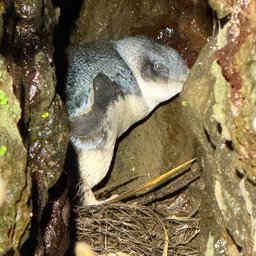
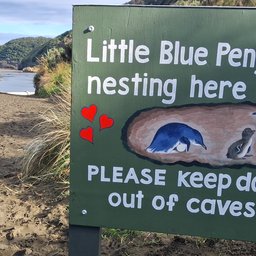

At this time of year, as darkness falls, small figures can be found waddling and hopping their way up the beaches along the Waitakere ranges. The Little Blue Penguins (kororā) are returning to their individual burrows at night from their fishing trips out in the Tasman. Just before dawn, many will head out again for another feeding session. Because they nest in burrows and caves along the shore, and come and go under cover of darkness, they are rarely seen by the public, and their overall population is not well characterized.
Four conservation groups in the Waitakere ranges are working to combat this lack of information and to protect the Little Blue Penguins that nest along our west coast beaches. The four groups - from north to south: Muriwai Environmental Trust (MET), Kororā Te Henga, Pest Free Piha and Karekare Landcare - are collaborating with the teams at Auckland Zoo and the NZ Penguin Initiative to monitor progress of these little birds.
Little Blues, the smallest of all the penguins, are the only penguin commonly seen in the northern half of the North Island, but they occur almost all around the New Zealand coast. The exception is the Otago coastline (including the large colony that is a tourist attraction at Oamaru); this part of our coast has been settled by the very similar Australian version of kororā, which Australians call the Fairy Penguin.
Work by the four conservation groups finding burrows and counting tracks has shown that there is a population of Little Blue Penguins resident on the west coast of the Waitakere ranges. Currently they estimate that there are around 150 pairs. Although many nest in the small, less-well-populated bays, there are also a good number on the more popular beaches. Increased public awareness of kororā activity along our coastline is critical to help these little taonga thrive.
A major focus of the mahi by the four groups has been to provide nest boxes. As well as allowing easier monitoring of breeding progress throughout the season, the boxes provide some protection against predators, particularly dogs. The birds typically lay in late winter and raise their chicks over spring and early summer. At this time parents are regularly coming and going to feed their rapidly growing offspring. Once chicks fledge, the birds usually leave their home beach for a few months except when they return to moult – the annual replacement of their feathers. They are very vulnerable during this stage, since they are unable to swim and must stay ashore for 2-3 weeks, losing up to 40-50% of their body weight in the process.
The birds face multiple threats on land, including predation by introduced pests as well as by domestic dogs and cats, vehicles on beaches or on roads that they cross to reach their nests, and increasing population pressure this close to our biggest city. Kororā are often found in caves around the west coast beaches, making them especially vulnerable to dogs while they’re nesting or moulting.
Ocean warming is also developing as a major issue, since their prey species (small fish, such as anchovies) like cooler waters and the birds are only able to dive and fish in the top 15-20m of water. This has been a big issue recently on the east coast, and it is hoped that the cooler waters of the west coast might provide some sanctuary for these intrepid little birds.