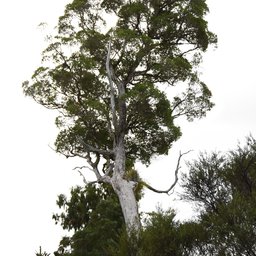
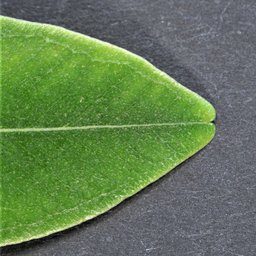
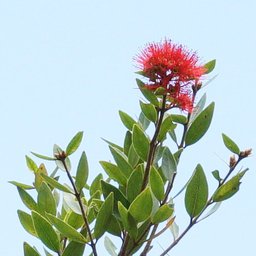
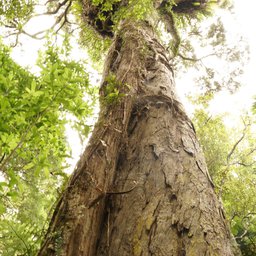
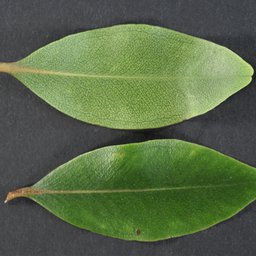
Northern Rata can grow up to 30 m high and its trunk can reach 2 m in diameter. It is a close relative to the Pohutukawa and they look similar with both producing bright red flowers in summer. Northern Rata differs from Pohutukawa, however, by having a tall narrow growth form and a straight trunk whereas Pohutukawa tends to sprawl out from multiple stems at its base. Both species have elliptic shaped leaves but you can identify the leaves of Northern Rata by the small notch at the tip of the leaf.
Northern Rata usually establishes as a perching seedling high in another tree such as rimu. It then sends a root down to the ground which enlarges over time into a substantial trunk with claw-like arms that wrap around its host tree.
Northern Rata prefer to grow on ridge tops and there is a wonderful stand of them on the Scenic Drive. Northern Rata was once very abundant throughout much of the North Island but it has suffered badly from possums that repeatedly strip the leaves until the tree dies, and so it has disappeared entirely from large tracts of forest.
Both Pohutukawa and Northern Rata are most closely related to other species within the genus Metrosideros that come from the tropical eastern Pacific such as Hawai’i. Generally, plant groups have originated in the tropics and then dispersed to temperate regions like New Zealand but Metrosideros originated in New Zealand and dispersed to the tropics. Once in the tropics, Metrosideros diversified rapidly such that there are now 45 species in the tropics compared to 11 in New Zealand, one in South America and one in South Africa.