Len’s Plant of the Month:
Veronica bishopiana (formally Hebe bishopiana).
Family: Plantaginaceae
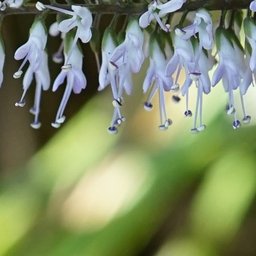
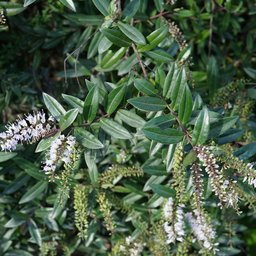
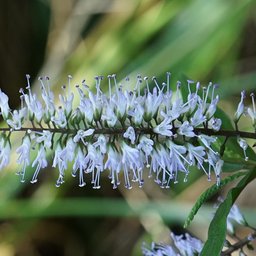
Veronica bishopiana is the only woody plant species with a natural distribution confined to the Waitakere Ranges. It can only be found from the upper Anawhata and Waitakere Stream south along the coast to Destruction Gully on the Manukau. It is a low growing, sprawling shrub that drapes itself down steep cliff faces. It has dark green, or reddish, narrow leaves and red stems. Its flowers (white, tinged pink or purple) are clustered along spikes that are about 17cm long. It prefers south-facing cliff faces and steep gullies where there is water seepage. This habitat, however, is also the favoured habitat of invasive Mexican Daisy, Mist Flower and Pampas Grass, and it is competition from these plants, along with possum browse, that threaten its survival. Some of the sites where this rare and special plant is hanging on in quiet desperation are dusty roadside banks where they are especially vulnerable to invasion by weeds and the indiscriminate rotary road-side slashers.
The Waitakere Ranges has three other Veronica species: V. macrocarpa, V. stricta, and V. obtusata.
From these species Veronica bishopiana can be distinguished by its low sprawling habit, red stems, and dark-green to red, narrow-tipped elliptic leaves. Veronica obtusata is also a low growing sprawling shrub but instead of having narrow elliptic leaves, V. obtusata has shorter, blunter-tipped leaves. Veronica macrocarpa and V. stricta both grow into small, upright trees.
Len’s Pest of the Month:
Mexican Daisy
Erigeron karvinskianus Family: Asteraceae (daisy)
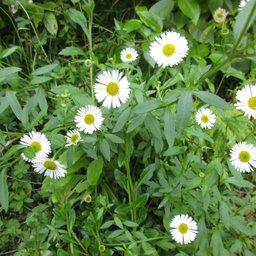
Mexican Daisy forms dense mats and produces large amounts of seed that disperse long distances. It tolerates moderate shade to full sun, damp to drought conditions and will grow in sand, mud, gravel, or tiny cracks in solid rock. It is most prevalent on roadsides and track banks and has invaded all of the newly urbanised tracks. It is a nasty pest because it is extremely invasive and threatens our endemic Veronica bishopiana. Unfortunately, il-informed and wilfully negligent garden owners tend to illegally propagate it. If you have it on your property or in nearby bush, or on nearby road banks, please get rid of it. If you see it on someone else’s property, please ask them to get rid of it.
Control options:
- Easy to dig or pull out but ensure you extract the roots or it will regrow.
- Spray with glyphosate (360 g/L strength) (mix 10 ml per litre of water) and add penetrant (1ml/L). Note that most native ferns, sedges and woody plants are resistant to glyphosate but if some damage does occur when controlling Mexican Daisy, it is still worth doing because all low-growing native plants will be smothered and killed off by the daisy if it is left unchecked.
- Spray with Clopyralid (300 g/L strength) (mix 12.5 ml per litre of water). Clopyralid is a herbicide for selective control of plants in the daisy family and some broadleaf weeds.